
Western Australian Legacies of British Slavery Project
Slavery’s Legacies
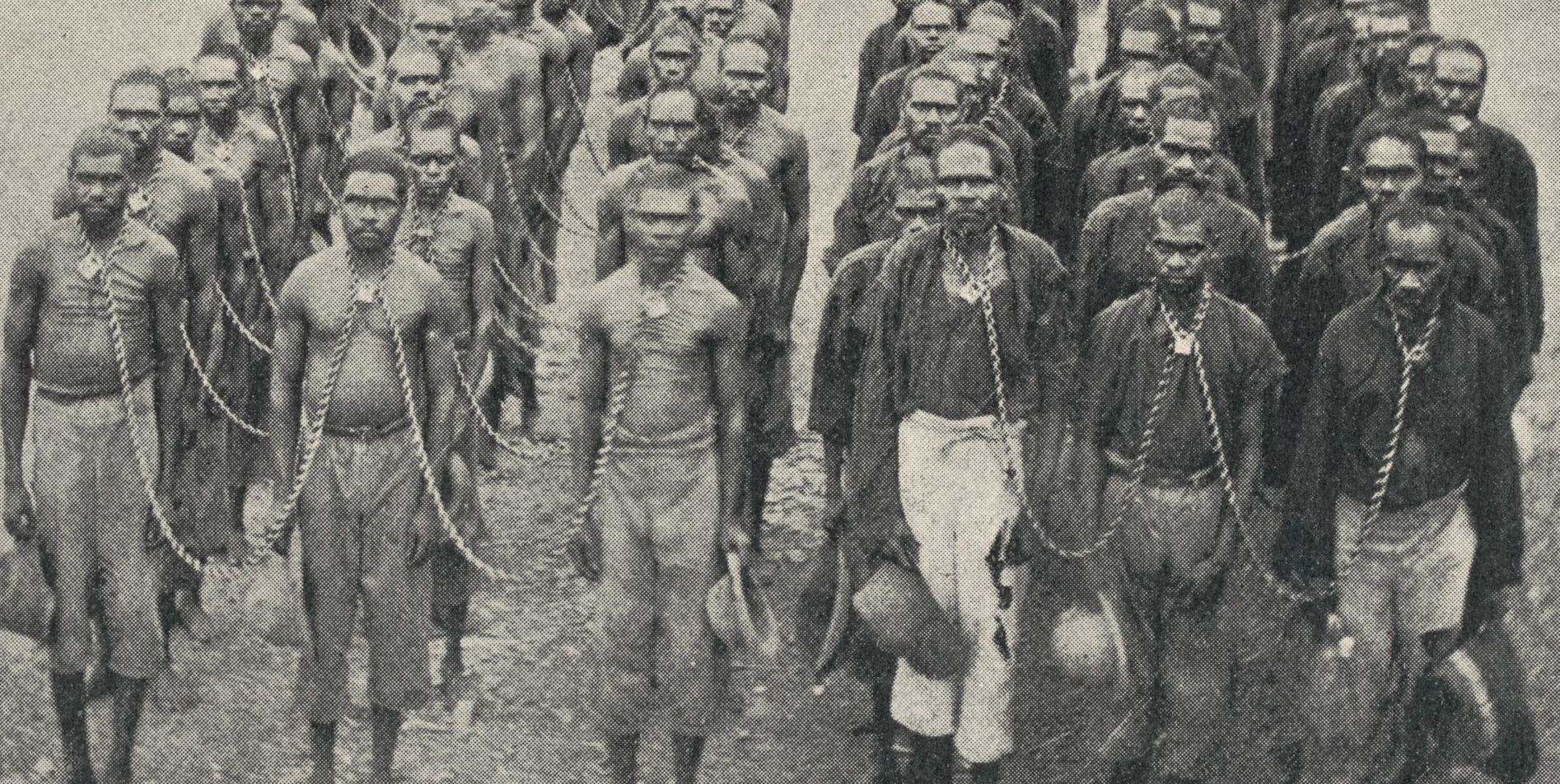
‘Aboriginal bathing gang’, ‘The Aborigines question’, The Western Mail, illustrated supplement, 18 February 1905, p. 24.
This image is taken from a newspaper feature published in 1905 and shows an ‘Aboriginal bathing gang’, at Wyndham, north-western Western Australia. While it seems so shocking to us now as evidence of colonial injustice and brutality, at the time this was published many observers regarded the image as proof of the prisoners’ humane treatment. Humanitarians drew on British anti-slavery discourse to protest against Aboriginal neck-chaining. Today, Aboriginal communities from the Kimberley advise that they wish these difficult stories to be told.
The Abolition of Slavery
In August 1833 British Parliament abolished slavery in the British Caribbean, Mauritius and the Cape when it passed the ‘Act for the abolition of slavery throughout the British Colonies, for promoting the industry of manumitted slaves, and for compensating the persons hitherto entitled to the services of such slaves.’ In place of slavery the negotiated settlement established a system of apprenticeship and granted £20 million in compensation, to be paid by British taxpayers to the former slave-owners. Since 2009 the internationally acclaimed Legacies of British Slavery project has explored how the fruits of slavery were transmitted to metropolitan Britain, creating a database of the 46,000 compensation claimants that connects them to the slaves and estates whose ‘loss’ they suffered.
Overlooked Histories of Slavery
The legacies of British slavery have been suppressed both in Britain and its former colonies, despite their powerful economic, cultural and legal consequences. Since 1833 Britain has proudly celebrated the abolition of slavery, yet its long antecedent history of participation in the slave trade has been largely omitted from scholarly analysis and popular memory. Historical repression has proven to be more pronounced in former colonies such as Australia, where preliminary research indicates that slave wealth and culture constituted a significant and ongoing historical force.
Many existing histories and resources overlook this framework – such as the Australian Dictionary of Biography (ADB), established in the 1960s, which almost entirely omits links to slavery.
Preliminary research showed that some of the compensation received by slave owners was likely invested directly in the financial infrastructure and land development of early colonial Australasia. Through biographical research the project tracked not only the individuals who claimed compensation, but the familial, social, commercial, administrative and political networks that constituted and sustained imperial connection.
Western Australia and British Slavery
Western Australia, founded in the 1820s as debates about emancipation and colonisation were intensifying, provided an alternative destination to the Caribbean for the investment of capital, goods and people. Recent work by a handful of Australian and British historians has traced this movement toward new markets and opportunities, revealing links between the sugar industry in the West Indies and Queensland and gold-rush Victoria, emancipation in the West Indies and the establishment of Swan River, and the ways that imperial careers instantiate the connections between slavery and settler colonialism. Using the LBS databases, this project helped track those who benefited from slavery and their subsequent interests in WA through familial, social, commercial and professional networks. Labour is a distinctive theme in WA history: unlike the other Australian colonies, WA was founded as a free settlement. Demand for labour prompted the transportation of small numbers of juvenile offenders from 1842, and it functioned as a penal colony between 1849 and1868. WA also remained under British governance until 1890 and so offers an especially clear picture of British policy in this period.
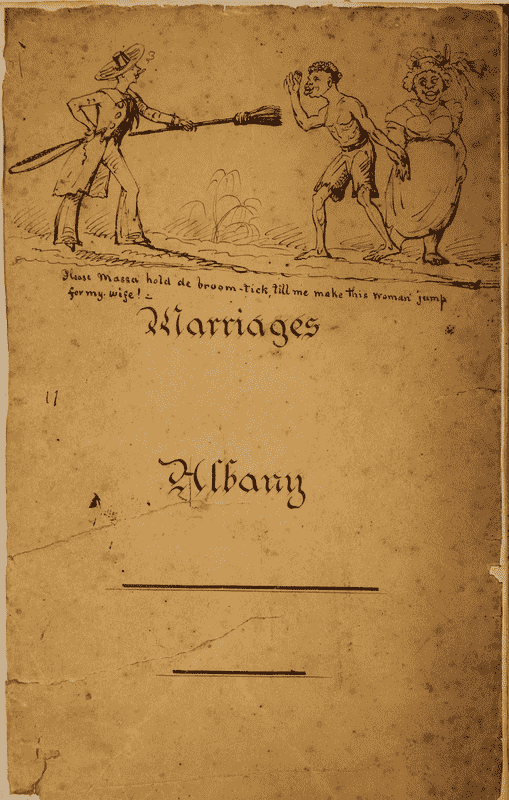
Front cover, Church Registers: Albany Marriages, Marriage Notices and Declarations (1839-1856). AU WA S4043-cons703_7 https://archive.sro.wa.gov.au/index.php/transcript-of-church-registers-albany-marriages-marriage-notices-and-declarations-07
This drawing, dated to 1842, may be associated with the career of John Randall Phillips (1789–1852) thought to be the grand-son of a wealthy slave-owner in Barbados, John Randall Phillips (1724–1773). Phillips junior was born at St Michael, Barbados, but was educated in Bristol at Redland Hill House, a boarding school run by his father George and attended largely by members of the West Indian families. He travelled to Swan River in 1829 on the ‘first fleet’ along with many other investors planning to become landed gentry—ignoring the First Nations people already in occupation. He was the Resident Magistrate of WA’s regional port town Albany in 1842.
The cartoon shows a couple ‘jumping the broom’, a practice closely associated with the marriage of enslaved people in the southern states of America during the 1840s—and revived within twentieth century African-American culture during the 1970s. Is this drawing linked to Phillips’ West Indies background? Or does it suggest links to the ‘slave states’ of America?
Sources:
Chapman, Tom, and Sally Grundy ‘Speeches about John Randall Phillips and George Braithwaite Phillips.’ ACC 9645AD/1: Synopsis of John Randall Phillips, 2017. https://purl.slwa.wa.gov.au/slwa_b5089179_1.pdf
Dundes, Alan. “‘Jumping the Broom’: On the Origin and Meaning of an African American Wedding Custom”, The Journal of American Folklore, 1996.
Legacies of British Slave-ownership, University College London. https://www.ucl.ac.uk/lbs/
Parry, Tyler D., Jumping the Broom: The Surprising Multicultural Origins of a Black Wedding Ritual (The University of North Caroline Press, 2020)
(NB there are other men of this name alive during the 1830s as the LBS database details: https://www.ucl.ac.uk/lbs/person/view/2146631832 )
Project Outcomes
We worked with the National Centre for Biography to develop a series of short biographies of figures associated with British Slavery. These are being published in People Australia, the NCB’s universal dictionary of biography.
Shakespear Hamilton: Sandy McGhie and Xavier Reader,” Shakespear Hamilton,” People Australia, National Centre of Biography: Australian National University (2022)
Maria Schaw: Sandy McGhie and Xavier Reader, “Maria Susan Schaw,” People Australia, National Centre of Biography: Australian National University (2022)
George William Mangles: Sandy McGhie and Xavier Reader, “George William Mangles,” People Australia, National Centre of Biography: Australian National University (2022)
Edward William Butcher: Sandy McGhie and Xavier Reader, “Edward William Butcher,” People Australia, National Centre of Biography: Australian National University (2022)
Peter Pegus: Xavier Reader, Georgina Arnott, Jane Lydon and Zoë Laidlaw, “Peter Pegus,” People Australia, National Centre of Biography: Australian National University (2022)
Publications
2022. “Writing Slavery into Biography: Australian Legacies of British Slavery”. Special Issue, Australian Journal of Biography and History. (6) https://press.anu.edu.au/publications/journals/australian-journal-biography-and-history/ajbh-6
Martens, Jeremy. 2022. “‘In a State of War’: Governor James Stirling, Extrajudicial Violence and the Conquest of Western Australia’s Avon Valley, 1830–1840.” History Australia. https://www.tandfonline.com/doi/full/10.1080/14490854.2022.2072351
Lydon, Jane. 2022. “Racial Punishment from Slavery to Settler Colonialism: John Picton Beete in Demerara and Swan River.” Slavery & Abolition. https://www.tandfonline.com/doi/full/10.1080/0144039X.2022.2122713
Exhibition
An exhibition titled Chains of Empire and based on the project team’s research was hosted by the Australian National Maritime Museum between August 2025- July 2025. It was based on project research as well as research assistant/ curator Isabel Smith’s research under the oversight of CI Paul Arthur. The exhibition comprised a wall display as well as two interactive installations: a Q&A screen hub designed to test visitors’ understanding of slavery and its legacies; and a mapping screen presenting data which had been visualised by the TLC project.
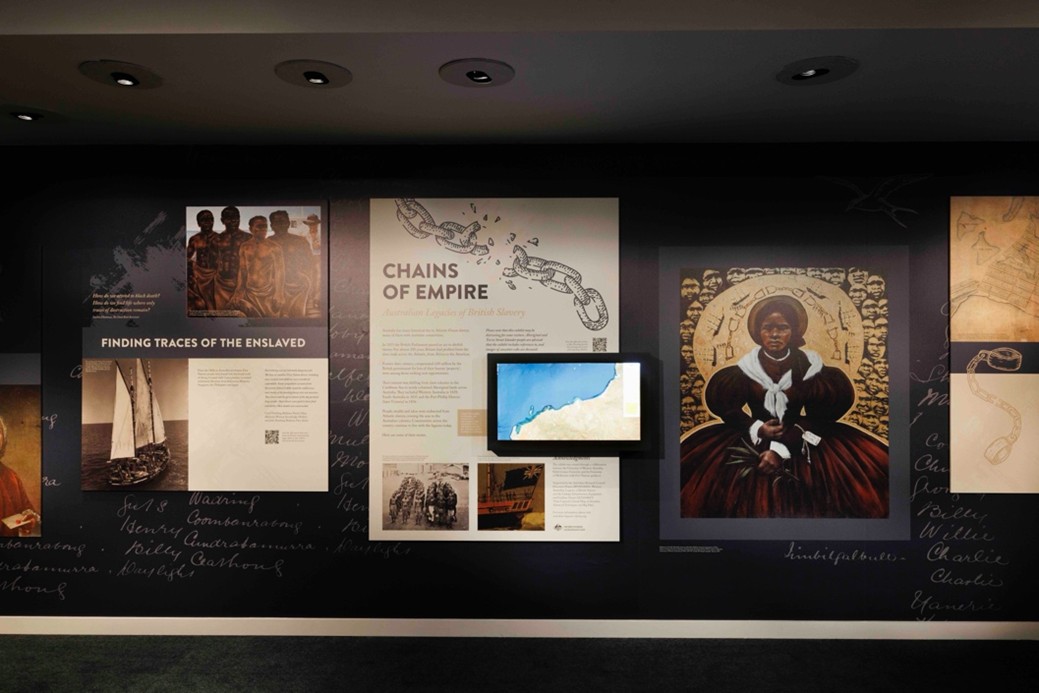
(Above: ‘Chains of Empire’ courtesy of Australian National Maritime Museum)
Engagement
Georgina Arnott, ‘James Stirling (1791 – 1865), enslavement and Western Australia’, 14 February 2022, Centre for the Study of the Legacies of British Slavery blog, https://lbsatucl.wordpress.com
Georgina Arnott was selected for a highly competitive ABC internship as an ABC Top 5 Humanities Scholar (2021) and produced an episode of Radio National’s History Listen, ‘Commemorating James Stirling?’.
https://www.abc.net.au/listen/programs/the-history-listen/commemorating-james-stirling/13642650
Georgina Arnott, ‘Commentary: Links in the Chain: Legacies of British slavery in Australia,’ Australian Book Review, no. 423, August 2020
https://www.australianbookreview.com.au/abr-online/archive/2020/august-2020-no-423/830-august-2020-no-423/6620-links-in-the-chain-legacies-of-british-slavery-in-australia-by-georgina-arnott
(This was re-produced as a podcast https://www.australianbookreview.com.au/reading-australia/germaine-greer/760-the-abr-podcast/12925-links-in-the-chain-legacies-of-british-slavery-in-australia-by-georgina-arnott-the-abr-podcast-196 )
Arthur, Paul Longley, Isabel Smith, and Lydia Hearn. “Crowdsourcing in Museums: The Power of Community Engagement.” Paper presented at the 5th World Conference on Social Sciences, Berlin, Germany, December 2022.
Arthur, Paul Longley. “Directions in Humanities Research Infrastructure.” Invited paper presented at the Mapping Culture and History workshop, NUSpace, University of Newcastle, Australia, November 2022.
Zoë Laidlaw, talk, ‘Australian Legacies of British Slavery’, Coburg Historical Society and Moreland Libraries, 19 October 2022.
Jane Lydon and Zoe Laidlaw, ‘Friday essay: beyond ‘statue shaming’ — grappling with Australia’s legacies of slavery,’ The Conversation July 9, 2021. https://theconversation.com/friday-essay-beyond-statue-shaming-grappling-with-australias-legacies-of-slavery-162934
Jeremy Martens, ‘New research shows WA’s first governor condoned killing of Noongar people despite proclaiming all equal under law,’ The Conversation, September 14, 2021. https://theconversation.com/new-research-shows-was-first-governor-condoned-killing-of-noongar-people-despite-proclaiming-all-equal-under-law-165871
Media interview, ‘William Crowther’s statue is coming down – but is that the only way to reckon with our history?’ ABC News, https://www.abc.net.au/news/2022-08-19/more-challenges-to-colonial-statues-to-come/101337858?utm_campaign=abc_news_web&utm_content=link&utm_medium=content_shared&utm_source=abc_news_web
Radio interview: Early Photographs of the Enslaved in Harvard University’s Peabody Museum, Law Report, Radio National, ABC, 11 July.
https://www.abc.net.au/radionational/programs/lawreport/vanuatu-climate-court/13965770
Numerous community talks, e.g.: ‘Our Slavery Legacy’, Glyde-In Community Learning Centre, East Fremantle. 21 February 2024.
Visualisation
CI Professor Paul Arthur and research associate Isabel Smith from Edith Cowan University used project research as the basis for visualising historical mobility and connections, using the Time-Layered Cultural Map (TLCMap), a suite of no-code or low-code digital mapping tools supported by the Australian Research Data Commons. Developed with an ARC Linkage, Infrastructure, Equipment and Facilities (LIEF) grant and later co-investment from the ARDC, TLCMap was launched in 2020 for HASS and Indigenous researchers.
TLCMap also allows people, objects and events to be plotted on maps. This enabled the WA Legacies team to visualise the flow of British colonisers from the Caribbean to Australia. Using TLCMap, charted the journeys of Walcott, Ridley and several other British colonisers who left the Caribbean for Western Australia. Drawing on the WA Legacies team’s biographical research, they were able to plot and timestamp every stop the colonisers made with annotations detailing their ties to slavery and their activities at each location. They then stacked the maps together using TLCMap’s multilayer function to compare the colonisers’ movement.
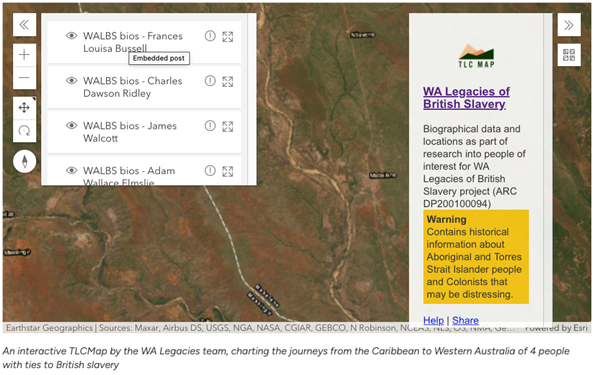
See: Jason Yuen, ‘Telling Human Stories with Time-Layered Cultural Maps’, Impact Case Studies, Australian Research Data Commons, https://ardc.edu.au/case-study/telling-human-stories-with-time-layered-cultural-map/#citation_Lydon
PhDs
The Postdoctoral Fellow, Dr Georgina Arnott, contributed extensive research and publication outcomes as well as media engagement through her role from 2020-2022. In 2023 she departed the project to take up a deputy editorship at the Australian Book Review, where she has recently become chief Editor.
Two doctoral projects were successfully completed: Dr Aoife Nugent, ‘From slavery to a Swan River settlement: three family histories in the Indian Ocean, 1770-1850’ (2023). Dr Nugent secured a research position before taking maternity leave in 2024.
Dr Naomi Preston, ‘Interpreting Western Australia’s difficult histories of incarceration, punishment and forced labour: Reconciliation and Decolonisation in the Heritage Space’ (2024). Awarded 2025.
Further Publications
Arnott, Georgina, ‘James Stirling (1791 – 1865), enslavement and Western Australia’, 14 February 2022, Centre for the Study of the Legacies of British Slavery blog, https://lbsatucl.wordpress.com/
Arnott, Georgina, ‘Linger With the Voids’, a review of Black Ghost of Empire by Kris Manjapra, Australian Book Review, pp 27 – 29.
Arthur, Paul Longley, and Isabel Smith. “Digital Representations of Slavery in Australia: Navigating Heritage, Identity, and Power.” In Digitising Heritage: TransOceanic Connections Between Australia and Europe, edited by Carsten Wergin and Stefanie Affeldt, 47–62. Heidelberg, Germany: Heidelberg University Publishing, 2024.
Arthur, Paul Longley, and Isabel Smith. “Exhibiting Slavery in Australia: Personal Narratives and Legacies,” Curator: The Museum Journal (2024):
https://doi.org/10.1111/cura.12640
Arthur, Paul Longley, Lydia Hearn, Isabel Smith and Nikos Koutras. “How ‘Open’ are Australian Museums? A Review through the Lens of Copyright Governance,” Internet Histories 8, 1–2 (2024): 136–52.
Arthur, Paul Longley, and Isabel Smith. “Human Journeys in the Digital Age: Advances and Challenges in Digital Historical Migration Studies.” Frontiers in Human Dynamics 4 (2022). https://doi.org/10.3389/fhumd.2022.915978
Arthur, Paul Longley, and Isabel Smith. “Exhibiting Slavery: Biographical Approaches,” Australian Journal of Biography and History no. 6 (2022): 171–88. http://doi.org/10.22459/AJBH.06.2022
Laidlaw, Z. ‘The Antipodean Legacies of Atlantic Slavery,’ Agora (2021), 56:3, 16-19.
(Professional journal of History Teachers Association of Victoria)
Lydon, Jane, ‘Confusion to all Sneaks’: Protection and punishment on the 1880s Western Australian frontier’, in Aftermaths: Colonialism, Violence and Memory in Australia, New Zealand and the Pacific, edited by Angela Wanhalla, Lyndall Ryan and Camille Nurka (Dunedin: Otago University Press, 2023), 149-156, 268-69. 9781990048449
Lydon, Jane, ‘Racial Punishment from Slavery to Settler Colonialism: John Picton Beete in Demerara and Swan River’ Slavery and Abolition (2023) 44(1): 1-25. DOI: 10.1080/0144039X.2022.212271
*Short-listed for the 2024 Margaret Medcalf Award, State Records Office of Western Australia
Lydon, Jane, ‘The Legacies of British Slavery in Australia’s Labour History’, Labour History: A Journal of Labour and Social History 123 (2022): 86-94, muse.jhu.edu/article/869924
Lydon, Jane , ‘From Demerara to Swan River: Western Australian Legacies of British Slavery’, Australian Journal of Biography and History 6 (2022), 23 – 49, DOI: 10.22459/AJBH.06.2022.02
Lydon, Jane, ‘“Mr Wakefield’s Speaking Trumpets”: Abolishing Slavery and Colonising Systematically’, The Journal of Imperial and Commonwealth History (2022), 50:1, 81-112, DOI:10.1080/03086534.2021.1956834.
Martens, Jeremy. “Forced Labour, Indenture and Convict Transportation: A Case Study of the Western Australian Pastoral Industry, 1830–50.” Labour History: A Journal of Labour and Social History 125 (2023): 31-54. muse.jhu.edu/article/910711
Martens, Jeremy, ‘”In a State of War”: Governor James Stirling, Extrajudicial Violence and the Conquest of Western Australia’s Avon Valley, 1830-1840’, History Australia 19, No. 4 (2022), 668 – 686. https://doi.org/10.1080/14490854.2022.2072351
Martens, Jeremy, ‘New research shows WA’s first governor condoned killing of Noongar people despite proclaiming all equal under law’, The Conversation, 14 September 2021. https://theconversation.com/new-research-shows-was-first-governor-condoned-killing-of-noongar-people-despite-proclaiming-all-equal-under-law-165871
Nugent, Aoife. “From Slavery to a Swan River Settlement: Three Family Histories in the Indian Ocean, 1770 – 1850.” PhD thesis, University of Western Australia, 2023. https://research-repository.uwa.edu.au/en/publications/from-slavery-to-a-swan-river-settlement-three-family-histories-in